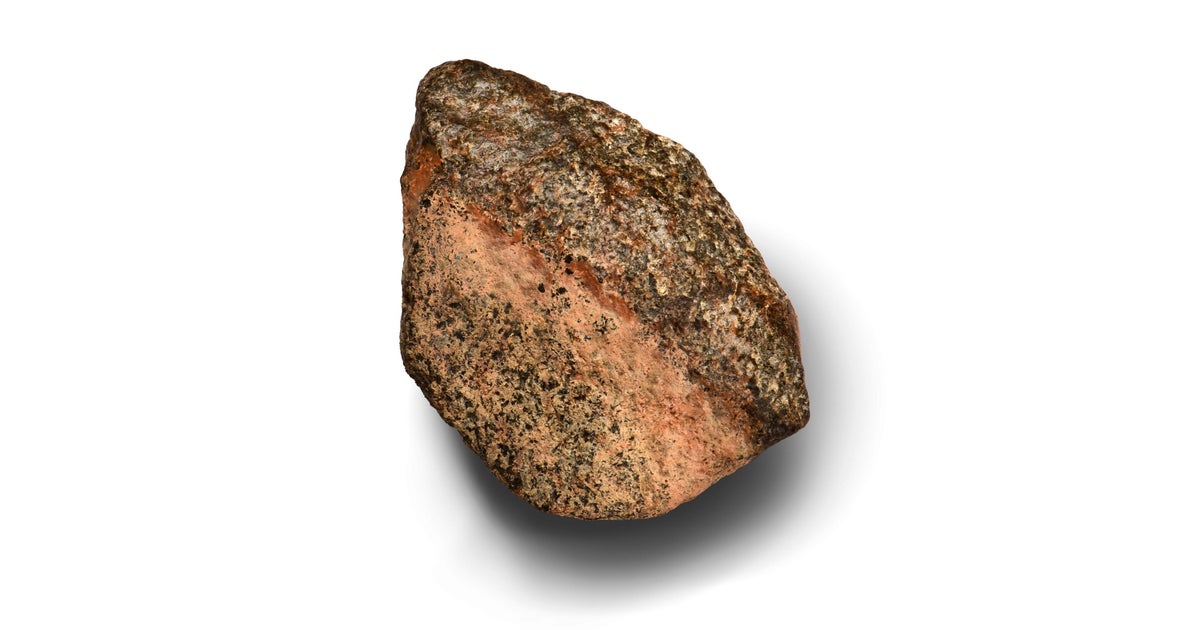
A nearly two-pound meteorite recovered from the Sahara Desert in Mali has been confirmed as a piece of Mars roughly 4.1 billion years old, according to a NASA study reported by CBS News. The rock, named Teghaza 001 after the salt flat where it was picked up in 2022, is now counted among the three most ancient Martian meteorites ever found on Earth, NASA said in a news release.
The space agency announced the findings on Friday, October 30, 2026. Reuters and Ars Technica also covered the identification, and Scientific American reported on its possible implications for understanding the origins of life.
Why it matters
Only about 435 meteorites on Earth have been confirmed as Martian, and NASA says most of them offer limited windows into the planet's past. Teghaza 001 is different: the agency describes it as providing a rare snapshot of how the Martian crust took shape and how it was later transformed.
According to NASA, earlier ancient Martian meteorites each captured a narrower slice of the planet's history. This specimen appears to preserve evidence of two separate chapters — the cooling of magma that built the crust, and the later action of water at the surface. Scientific American reported that the oldest known piece of Mars may even help researchers probe mysteries surrounding the origin of life on Earth.
Yang Liu, the lead author of the paper describing the dating work and a researcher at NASA's Jet Propulsion Laboratory in Southern California, said the rock's significance only became clear under close examination. "It was only after we started looking closely that we realized this meteorite is really unique," Liu said, according to NASA's release. Liu added that one of the paper's reviewers described the specimen as a Rosetta Stone for Mars.
A volcanic mix that matches orbital observations
NASA said the meteorite consists of an unusual combination of volcanic minerals, including zircon crystals. That composition lines up with what the agency's Mars Reconnaissance Orbiter has observed in the planet's southern highlands, tying the find to a specific region of the Martian surface.
To establish the rock's age, the team turned to Francis Tissot, a geochemistry professor at Caltech, who helped apply a pioneering dating technique to a fragment of the meteorite smaller than a fingernail. The method is precise enough to analyze individual mineral grains, NASA said.
That grain-level analysis indicated the rock was altered by Martian water about 4.1 billion years ago. The rock itself may have formed even earlier, according to the agency. The data also suggested that early Mars may have had a more active water cycle than scientists had previously assumed.
Lee Saper, another author of the paper, said the meteorite preserves a record of those interactions. According to NASA's release, Saper said the rock "records interactions of water and rock and maybe even an imprint of the Martian atmosphere as it was losing water."
A separate study of the meteorite, published in June, examined its water content and considered how water may have shaped the early Martian landscape.
Lee Saper, a scientist at NASA's Ames Research Center, framed the find as a first for planetary science. "This is really our first piece of Martian crust from a part of Mars we've never had a sample of before," Saper said, according to NASA.
How scientists know it came from Mars
Researchers confirm a meteorite's Martian origin by comparing its chemical and mineral makeup against samples and data gathered by NASA's missions to the planet, the agency said. That matching process is what allows a rock found in a desert on Earth to be tied to a specific world hundreds of millions of kilometers away.
The identification of Teghaza 001 adds to a small but closely studied collection. NASA's count of roughly 435 confirmed Martian meteorites underscores how uncommon such finds are, and how much weight each new specimen carries for researchers reconstructing the planet's early history.
The paper's findings rest on laboratory work rather than a spacecraft mission, a reminder that rocks that fell to Earth long ago can still supply evidence about worlds that probes have only begun to survey.
What to watch: whether further laboratory work on Teghaza 001's remaining material can narrow the timing of when the rock itself crystallized, and whether the sample's mineral signature can be matched more precisely to specific terrain observed by orbiting spacecraft.